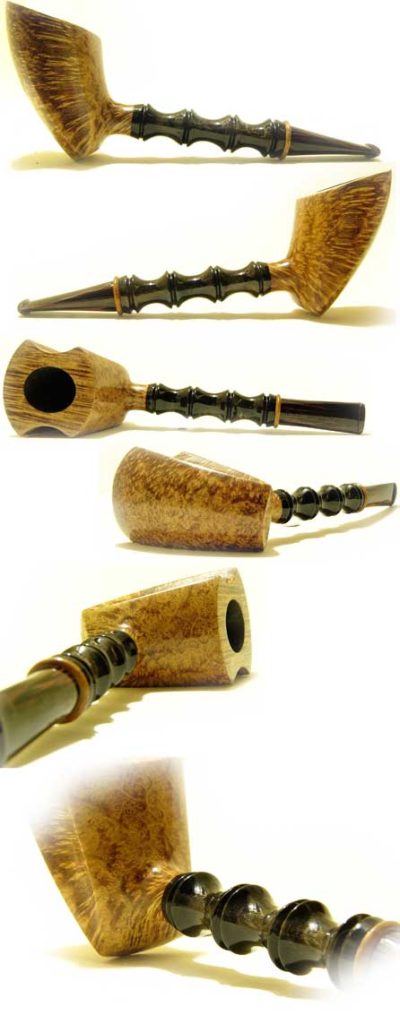
Early this year I was told that the pipemaker Love Geiger and his Sara were expecting a baby, and for that reason they were looking for new, more spacious premises. “Very convenient that Love has his workshop in a circus wagon,” I thought, “that wagon they can take with them where ever they go.” But that is not what happened; a little later I heard they were moving to an old school and that there was plenty of space for a workshop.
On the 20th of February Sara gave birth to a daughter who was named Indra Vilja Katja, and one month later I had the opportunity to meet this charming little girl at my first visit to the new residence of the Geiger family. It was not hard to see the parents´ happiness about their daughter, and Indra was watchfully looking at the moustached older gentleman who made a trespass into their private little world.
Olseröd – a village with a view
Olseröd is a very small village situated on a hill only three kilometres from the east coast of Sweden, and the view towards the sea is stunning. On the highest point of that village the old school (it was built in 1914) is situated, and this is the new home for Love, Sara and Indra. The school closed in the early 50th, and now there are three apartments in the building. The apartment the Geiger family are living in is spacious with large rooms, as it often is in old buildings. One of the rooms Love has arranged into a very functional workshop.
“But what about the circus wagon, Love?” I wonder slightly embarrassed. That wagon is so rare and unique that it would be a disaster, if it was left to disrepair. “We will keep it”, Love assures me, “it will be left where it is and we will use it for our vacations in the future.” I felt relieved; such a wagon just has to be kept in order.
 Bamboo – or what?
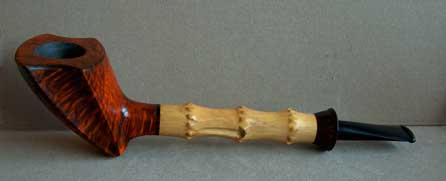
We are sitting in Love’s workshop. Sara and Indra serve us a cup of coffee and life is at its best. When I am looking out of the window, I can catch a glimpse of the sea far away; an inspiring view. I can see a few half-finished pipes in a stand, and after having seen Love’s site on the internet – where all pipes are marked “sold” – I suspect I will not see many finished pipes this time. However, on my request Love shows me two pipes, so new that he has not had the time to put them on his site. One of them is a horn, the other a long pipe with a shank made from bamboo – I think, until Love shows me that it is not so. The shank is actually made from boxwood! Lately it has become popular among pipemakers to make imitations of bamboo, but Love has gone one step further; he has made an imitation with knots and all, so perfect that I first thought it was real bamboo. A fantastic job, indeed!
Pipes with personal names
Love gives personal names to all his pipes, so I ask him what the two pipes he just showed me are called. “The horn is just called Concave Horn, but I have not found a name for the other one yet” Love tells me. “But I will think about it and mail you”, he adds. When I got home there already was a mail; Love had decided to call it The Erroneous Elephant. I think the explanation for that name is, that the pipe looks almost like the shape called Elephantfoot, but just almost. “Isn’t it difficult to find personal names for all new pipes”, I ask him, “it has become quite a few?” “Well, it was easier in the beginning”, Love answers somewhat avoiding.
 Termite-rustication
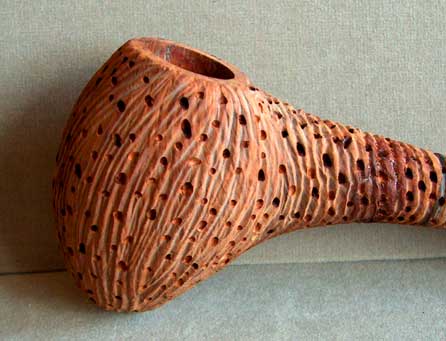
I see some half-made pipes with a very special appearance. The pipes have holes all over the surface, which make them look as if they were worm-eaten. Love calls it “termite-rustication”, which is made with a combination of sandblasting and rustication. First the pipe is blasted, then the small holes are drilled and finally the pipe is sandblasted again. This last sandblasting makes the holes irregular and makes them look natural. A very unusual and striking finish indeed!
Love is also trying a new material for the tenons. It is called Delrin, a plastic material. The advantage with this material is that it is “self-lubricant”, which means that it stays a little oily and the tenon is easy to turn. I tested some pipes at my visit and it seemed to work very well indeed.
New grading system
From now on Love will use a grading system for his pipes. The system is based on the Nordic Mythology and the following grades will be used on all smooth pipes:
Muspelheim, Nithavelir, Midgaard, Valhalla, Asgaard och Ygdrasil.
Ygdrasil is the highest grade and to cite Love himself, this grade will be used for ”those truly unique shapes with top quality grain.” Not very many pipes will get this top-grade. Preliminary the pipes will be stamped with the first and last letter of the name, but exactly how this will be done is not determined yet.
Love makes smooth, sandblasted and rusticated pipes. However, the equipment for sandblasting has not yet been moved to their new home in Olseröd. But there is a suitable space for it in an outhouse, a good placing for a noisy machinery like this.
 Special tools
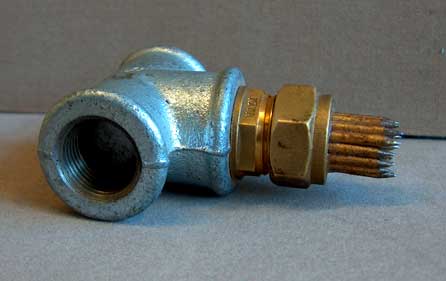
In a pipemaker’s workshop you almost always find some special tools, something the pipemaker himself has created. One such thing that caught my interest was a tool for rustication. It was made from a T-shaped connection for water-pipes, in which Love had attached a lot of very sharp-pointed nails. The tool is pressed to the surface of the pipe and then twisted; it makes an even and nice rustication. Simple and effective!
In a cupboard a lot of ebauchons are stored to dry. The order is perfect and every single block is carefully grinded and graded. I am sure, many beautiful pipes will be made from those blocks.
Chicago has to wait
So far Love has avoided retailers but sold his pipes via his site on the internet. However he has made one exception; he has a retailer in Russia. All countries in Eastern Europe are a rapidly growing market, and the interest in pipes from Scandinavia is very great indeed.
Love had planned to go to the pipe-show in Chicago in May, but he has now decided to wait until next year. Love wants to take his family with him, and Indra is still too young for such a long journey. And besides that, he has very few pipes to sell for the moment. But visitors to the pipe-show will get the possibility to see Love’s pipes anyway; the pipes he has ready will be exhibited by Per Billhäll of Scandinavian Pipes.
Outside the sun is shining from a clear sky, but a bitingly cold wind is coming from the sea. On the backside of the house a rooster and some hens are picking peacefully. I look at the beautiful view one last time, say good-bye to Love and get into my car. Sara and Indra have gone to the coast for a walk – I hope it was not too cold for little Indra, so that she will catch a cold.
Jan Andersson